Thursday, April 20, 2006

I took the Theological Worldview Quiz, and decided that it was a good thing that I am at a United Methodist Seminary.

You scored as Evangelical Holiness/Wesleyan. You are an evangelical in the Wesleyan tradition. You believe that God's grace enables you to choose to believe in him, even though you yourself are totally depraved. The gift of the Holy Spirit gives you assurance of your salvation, and he also enables you to live the life of obedience to which God has called us. You are influenced heavly by John Wesley and the Methodists.


Neo orthodox


71%

Evangelical Holiness/Wesleyan


71%

Roman Catholic


68%

Emergent/Postmodern


61%

Charismatic/Pentecostal


61%

Classical Liberal


57%

Reformed Evangelical


50%

Fundamentalist


36%

Modern Liberal


32%

What's your theological worldview?
created with QuizFarm.com


Monday, February 20, 2006

A Wee Little Sermon about a Wee Little Man (Zacchaeus)

I know Zacchaeus. He's hopping around, trying to see over the heads
of the crowd, frustrated. He's heard about Jesus, rumors about a
prophet who eats with sinners and even invited a tax collector to
follow him. It's a once in a lifetime opportunity, this chance to see
Jesus, and Zacchaeus can't see through the crowd.

I know Zacchaeus, because I am Zacchaeus. Finally at seminary, a once
in a lifetime opportunity, a chance to see Jesus…and instead I am
hopping around, trying to see over the heads in the crowd, unable to
see Jesus. Sometimes it's Old Testament. When the words "For unto us
a child is born, unto us a son is given", … are transformed from an
astonishing prophesy into Isaiah encouraging King Ahaz to stand firm,
hold out for help from the Assyrians.

It happens in ethics, two weeks studying process theology; everything
is part of God. In this model, God isn't powerful; God doesn't
intervene, but instead whispers possibilities. I look and look, and I
cannot see Jesus in the model.

It happens sometimes at my con ed placement, at the hospital. I know
I'm supposed to see Jesus when visiting the sick in the hospital. But
they don't look like Jesus. A patient shares that she is an
alcoholic, and bipolar, and cuts herself on her arms because she feels
empty inside and just wants to feel something, then I ask, "where are
you Jesus, I don't see you."

I look for Jesus with the older people in the geriatric ward. A few
seniors sit in the lounge. I turn off the tv and start singing old
hymns, What A Friend we have in Jesus, and patients shuffle out of
their rooms and join in the singing, not sure what is going on but
there's something familiar about Amazing Grace; maybe they also hope
to see Jesus.

This time I showed them pictures cut from old magazines.

They look at a picture of a boy with a baseball cap, and talked about
the games they played sixty and seventy years ago—they didn't play
baseball, they played stickball in the street. They kicked the can,
and they pretended to be cowboys and chased the Indians.

They look at a picture of a toddler in straw hat too big for his head.
Anna said, "He's working in the garden, that's why he has a straw
hat". Willie added, "That's his granddaddy's hat. He's wearing his
granddaddy's hat." They agree. That has to be granddaddy's hat.

Another picture--a girl on hilltop. The sun is shining, and she
stands with arms outstretched. They remembered summer days when they
held out arms and spun around and around until they were too dizzy to
walk. They remembered rolling down the hill, over and over, and then
afterwards being itchy from the grass.

We talked about how when a child smiles, you know that the child is
happy, and that makes everyone else happy. When a child is sad, you
can tell, and it makes you sad too. You can see straight through to
the inside of a child.

I asked them, where is God in this picture? Someone said, "God loves
the children." B.J. said, "That's what God sees when he looks at us.
God sees what we are really like, he sees us the way we are inside."
That's right, says Willie. He sees us on the inside. He loves us
just how we are, just like the children." I tell them about
Zacchaeus, climbing a tree, wanting to see Jesus.

I tell them about Zacchaeus, who leans out from a branch of a sycamore
tree trying to get a better view of Jesus. He's been working hard to
see Jesus, out of breath from racing to get ahead of the crowd,
scratched from climbing branches, eyes burning from late nights
studying, writing colloquy papers and just trying to see past the
crowd and understand what exactly is going on here…and Jesus, on his
way to Jerusalem, sees Zacchaeus the way he really is, a sinner in
need of a physician, a blind man longing to see, and most of all, a
son—no, a beloved son of Abraham, and Jesus calls out to him and says,
Come down. I've been looking for you.

Sunday, October 16, 2005

My Bible

I have spent the last three hours reading Miller-Hayes' History and Hayes' Interpretation of O.T.  I feel as though I have been hit, over and over, until beaten down.  Although, it's not really sharp pain as much as sadness...or grief.  I feel like I am losing my Bible.

I keep thinking about a lecture from History of Christian Thought a few weeks ago, when I heard about the Coptic monks who were persecuted in the 4th Century.  They were anthropomorphites, which means that they took the Bible so literally, that when the Bible says something about God's hand, or God's shield, they believed that God literally has hands and a shield.  They were persecuted as heretics, because obviously God doesn't have hands, or carry a shield.  

One anthropomorphite monk, having submitted to the ruling of a local council, confessed his errors, and said, "but they have taken away my God".

I think that the best thing I can do now is just go to the text and pray it, and delight in it, and maybe even sing some of it.

Saturday, October 15, 2005

Week 3

The big news for this week was Mark--he fell in a soccer game
Saturday. His wrist hurt, but brave boy that he is, he didn't
complain. We took him to the doctor Monday morning since everything
on the Internet said that if it still hurt a day later to go to
doctor, and he had broken a bone in the wrist. He has his first cast,
and has lots of signatures on it. He has to drink 5 glasses of milk,
or take a calcium table for each omitted glass, and so he swigs the
milk to avoid the horse pills.

Matt called Sunday (we try to talk every Sunday) and said that he had
helped kidnap new fraternity brothers and take them to Iowa for
football game. He was driving home. As we talked the cell signal
degraded, and he said he would call back soon. He didn't, and didn't
answer my calls since he went straight to work when returned to
Columbia, and turned off cell phone at work. I was so worried about
him, of course imagining him on the side of the road in rural
Missouri. He did call late, and I was so relieved. I really hate
being away from him and not knowing how he is doing.

One of the best parts of seminary is the worship opportunities. Three
days a week at midday, we have a service, usually with word &
Eucharist on Tues, word on Thurs, Eucharist only on Fri.

This week one of the third year students preached and did a wonderful
job. He spoke about "hitting the wall" the third week every semester.
I haven't "hit the wall" yet, I seem to be finding a rhythm of class,
study, weekly O.T. quizzes, writing weekly colloquy paper, rest, etc.
I estimate that I should be reading 180 pages a day for Tues-Fri
classes, and I get most done before class, but seem to slip and get
the Thurs morning readings done after class instead of before. I'm
more worried about next week when other classes start adding papers
and midterms. That's when I expect to hit the wall.

Our student preacher used a cute phrase--he called himself a card
carrying member of the "FPA"...which stands for "Future Pharisees of
America". He had some really clever lines about getting the card
laminated, whipping it out when needed...and it was a clever phrase to
use to make his point. Over lunch afterwards, a few of us decided
that the current definition of pharisee is anyone who doesn't agree
with what I believe. :-)

Part of the reason I feel better about the rhythm is that I'm finally
doing well on the O.T. quizzes. I started doing online trivia games
to help me remember details. I like the one at:
http://trivia.crossdaily.com/ which allows me to select a book of the
Bible to quiz from. I am a bit resentful about being quizzed about
details, like in which chapters of the Pentateuch do you find the
worship calendars, but it has changed the way I am reading the text to
be more careful about details.

Also, the Jewish study Bible doesn't have the mid-chapter subject
headings that I am used to, and I realize now how much I
subconsciously depended on these to tell me what I am reading, or to
go back and find a verse that I know is somewhere around chapter 13.

Wednesday, October 12, 2005

Week Two

I bought a digital recorder to record all of my class lectures, and
found that I can listen to lectures at 1.5 times normal speed, with
occasional stops to gloss my class notes. It makes me aware of how
much wasted time there is in a lecture. :-) Plus, it's fun to listen
to my professors talk fast in a high pitch.

Cathy suggested a daily 30 minute power nap, and this works well. I
set my timer 40 minutes when I get home, and if I don't get to sleep,
get up anyway. Friday I was tired, but other days went well. I know
it seems ridiculous to worry so much about sleep, but I think a lot
about this. It makes me feel old when I'm tired and look around at a
bunch of twenty-somethings in the classroom.

Met with my contextual education class. I will assist chaplain 4
hours per week at Gwinnett Medical Center. I would like to work
Monday mornings, since no classes then, but if I work mornings I will
likely be assigned to emergency room, since resident patients will be
bathing/eating breakfast, etc. I do not feel prepared for this at
all. But then I wasn't prepared at all for pastoral care last year,
and somehow got through this...grace happens.

My Old Testament class uses the Jewish study Bible, and the notes are
wonderful. It has more notes than Biblical text on some pages, so
more like a commentary than Bible.

I have procrastinated on deciding my attitude towards scriptures. On
the one hand, I believe that scripture is divinely inspired. On the
other hand, as my Old Testament prof continually points out, it is
difficult to accept the text literally. (And I cannot do like Origen
and say that the literal meaning is the least useful.) In O.T., we
don't ask "did it really happen like this?" but instead we ask "why
did the people tell the story in this way?" So far I have been able
to hold a paradox in my mind with no problem.

For my finance friends: does this conflict in beliefs mean that my
belief system is lexicographic?

In pastoral care we have focused on the paradigm shift during the 1990s in how to give pastoral care. Essentially there has been a paradigm shift, where the clinical model of one-to-one care based on a "standard" person has been criticized for many reasons. Many of these are related to shift towards a postmodern philosophy.


In finance, over this same time period we saw a shift from assumptions like investor rationality and homogeneous expectations to greater
acceptance of papers examining behavioral issues. I doubt many in finance would attribute this shift to post modernity in culture, but I have to wonder if some of the postmodern philosophy didn't leak over into this last bastion of rationality.


In pastoral care we write reflection papers...in one paragraph write a summary of a paper, then our reflections on the paper. I have no idea what this means, so I just followed directions and reflected on the paper. (When all else fails, read the directions.) There is a two page limit, and since papers are submitted electronically, I can't fudge in the usual ways-- making margins 0.9 inches, reducing the font to 11.9 instead of 12, instead of double spacing use a space of 1.9 between lines. This is the real curse of the electronic age. Below is my reflection on a paper by Ramsay, chock full of jargon (jargon is the only remaining means of meeting space limitations).

Toward a Trinitarian Image of Humanity
(Reflection on an article by Nancy J. Ramsay)

In her essay describing recent developments in contemporary pastoral theology, Ramsay describes how transitions in pastoral theology have coincided with the recent paradigm shift from modernity to postmodernity.[1] She identifies two theological themes with these changes, an increasing theological emphasis on creation in God’s image and love.[2] Ramsay also notes that theological reflection on the Trinity has led to a “more adequate theology of love that values mutuality and reciprocity”.[3] This essay argues that theological emphasis on creation in the image of God, and in particular, an image of God as Trinity, may address postmodern concerns.

Creation in a Trinitarian image of God could be modeled in at least two ways. In the simplest case, each human reflects a Trinitarian God. This suggests that people are complex and not easily pigeonholed, and is consistent with recent recognition of the “multiple social identities that persons inhabit”.[4] The complexity of the individual is congruent with postmodern concerns about pastoral care models based universal human experience.

Another concern of postmodernity, the role of authority, also could be addressed by a Trinitarian image of individual humans. Based on a Trinitarian self-image, oppressed groups that historically have been told to submit and sacrifice as Jesus did, can also view selves as not just imitators of Jesus, but draw on a Trinitarian self-image that includes God the creator and a powerful Holy Spirit.[5]

A second interpretation of humanity created in a Trinitarian image suggests that communities, rather than individuals, reflect the image of God. Genesis 1:27-28 describes a multi-person creator who creates humanity, males and females, in its own multi-person image. Only together, in community, can truth be found. This view would be appreciated within postmodernity, which questions the objectivity of individuals and values multiple perspectives.

A model of Trinitarian community suggests that individuals were created to be part of community. Emphasis on God in three persons, each promoting and supporting the others, could increase the willingness of a community’s members to relate to one another with mutual encouragement.[6] An increased emphasis on mutuality within community could address postmodern concerns about asymmetrical power and authority within relationships.

Although greater emphasis on Trinitarian theological anthropology may address some of the concerns associated with postmodernity, it is not without problems. One weakness of emphasizing the Trinity is that few, if any, understand the mystery of the trinity. Emphasis on the mystery of God may lead to resignation by some in their attempt at better self-understanding. If I cannot understand God, how can I hope to understand myself?

Second, a community’s goal of reflecting a Trinitarian God may be limited by its understanding of the persons of God. For example, the role of God as the creator may be associated with facilitating physical and emotional healing; that of Jesus the reconciler may be associated with assisting in reconciliation. However, it is not clear to this writer as to how the role of the Holy Spirit would be embodied within the community.[7] Despite these limitations, increased emphasis on the Trinitarian nature of God and creation in the image of God may address concerns of postmodernity and encourage Christian communities to meet the needs of persons for belonging.


[1] Nancy J. Ramsay, “Contemporary Pastoral Theology: A Wider Vision for the Practice of Love,” in Dictionary of Pastoral Care and Counseling, Expanded Edition, ed. Nancy J. Ramsay (Nashville, Abingdon Press, 2005), 1429.
[2] Ibid., 1434.
[3] Ibid., 1434.
[4] Ibid., 1435.
[5] This use of Trinity likely differs from that in the works by Gill-Austern and Johnson cited in Ramsay, Ibid., 1434.
[6] The Bible provides several examples of mutual support of Trinitarian persons for each other. For example, Mark 1:11 describes the baptism of Jesus, at which time a voice from heaven, said ‘You are my Son, the Beloved; with you I am well pleased.’.
[7] This weakness more likely reflects the weakness of the author rather than the weakness of a Trinitarian image of humanity.

Tuesday, October 11, 2005

Week One - So Tired

I keep telling myself that I am not behind, that I am caught up with
the things that matter...but then I notice it has been a month since
school started and not one blog item. Here's what I can recall of the
first week.

If I leave for school at 6:00 I can make it with time to spare for the
7:30 daily office, with plenty of time to get to the 8:00 class. I've
learned since then that even leaving at 6:05 may mean missing the
prayer service.

I'm not used to getting up so early, and was too excited to get much
sleep the first night. It is hard to get up and get out by 6. I
don't understand why this is so much harder than leaving the house by
7. Every day I seemed more and more tired.

Friday morning, as I was walking to my first class, a classmate
commented that he felt great! He had a great night's sleep, he had
gone to bed early, at 10pm. For this old lady, 10 pm is late!

At first I thought my least stressful class would be Old Testament.
The professor doesn't give tests/papers, just a quiz every class, and
students can drop 3 of the 26 scores. I studied, and prepared one
paragraph essay answers to the questions I anticipated. Instead, it
was fill-in-the-blank detail questions. I answered 3 of 5 questions,
and found out that two of those answers were incorrect when he went
through the quiz after we turned them in. 1 out of 5 points won't
work on any scale! I came home and immediately got out my scholarship
materials--and verified that I have to keep a 3.5 or lose the
scholarship. I was hoping that it was a 3.0 or 3.2. Oh well.

Spoke with Matt, who is freshman at Mizzou, and he gleefully told me
that he made an A on his first quiz. :-)

My Old Testament professor loves to point out the inconsistencies in
the texts. Some of what he sees as inconsistencies I have no problem
with. For example, in the creation account, he says "a day is a day"
and each day of creation would be 24 hours--he insists in interpreting
the text literally so that he can better point out inconsistencies.
But for me, I don't have a problem with this. I imagine Moses, or
some other prophet, seeing a vision of creation, and trying to express
and describe this as best possible--which means poetry.

History of Christian Thought is an amazing class. It's team taught.
One professor teaches for 50 minutes, the other addresses oversights
and also highlights themes in the previous lecture for 10 minutes,
then they both answer questions for 10 minutes. It's amazing to see
the interaction between a lover of church history and a lover of
liturgy. They bring out the best in each other. I'm so glad that I
listened to lectures on tape of philosophy (while painting Mark's room
this summer). It has helped a lot, since as a math/finance major I
never discussed Plato. Funny to have a PhD without ever taking a
philosophy class!

Sunday, August 28, 2005

What do you do when you don't have internet?

For the last 3 weeks my only access to the internet has been to drive to the library. It's been a good excuse to take a Sabbath and rest from being online.

For the first two weeks in our home we had access to one static-filled television channel. If the antenna moved by a hair, the picture changed to a snowy black and white. Poor Mark seemed to be going through withdrawal, and begged to go visit cousins (and their computer).

Part of the reason for the delay in connection was my resolution to never order internet cable / DSL, etc. No matter what I do, it's never enough research, there's always a better deal out there, so I have learned to let "Dear" do the research.

Dear arrived a week after us, and it took him a week to decide on DSL for internet access and satellite for t.v., and another week for service appointments. Every day Markwas asking when we would have internet and cable. The best part was when Ed preparared for the satellite service by connecting the t.v. to the cable outlets. Turns out that we had cable for 3 weeks and never realized it. Oh well, it was good for the family to have an electronic Sabbath.

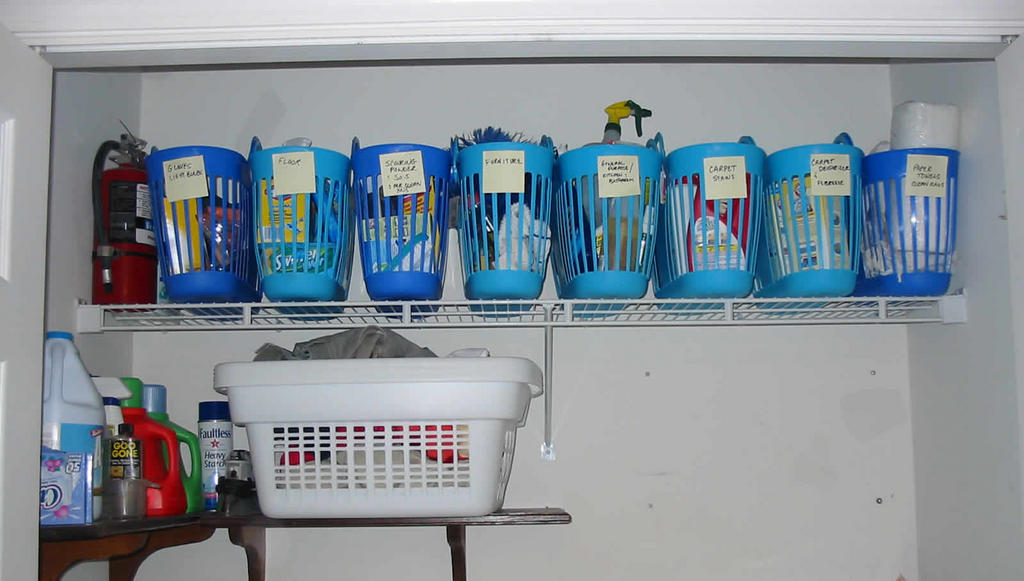
So what do you do with no internet access? Organize the laundry room of course!


Thursday, July 14, 2005

This is the home that we are purchasing in Canton, GA. Mark will be in one of the two upstairs bedrooms, and the ceiling is high enough to accomodate his loft bed.

There is some unfinished space in the basement for Ed's power tools.

The neighborhood has a "green space", a large green field behind the home maintained by the neighborhood association. The green space is in the flood plain zone, and so will never be developed. The previous owners loved flowers, and the house is surrounded by perennials like daylilies and azaleas.

The home is 5 minutes from Mark's school, Creekland Middle School.

Yes, the swing on the front porch comes with the house.

Asymmetric Information?

I was so excited when I saw the schedule request form for Fall semester. One of the courses offered is a full semester on preaching Deuteronomy. A whole semester studying Deuteronomy sounded so appealing, a great opportunity to get into the text. When I turned in my course request form, Deuteronomy was ranked as my number one selection.

While waiting to learn which courses were scheduled, I started to worry a bit. The more I thought about this, the more certain I was that by the time my registration request was processed, the Deuteronomy course would be filled with 2nd year students and this newbie would be passed over.

I was so excited when I received my schedule, and saw that I was enrolled in the Deuteronomy course.

Curious about the instructor and class size, I found the course information on the registrar's website. The course limit is 12 students and so far there are 11 remaining seats. It's been over a month. No one else has registered for the course. Hmm...What does everyone else know that I don't know?

Schedule for Fall 2005

Tuesday / Thursday
Introduction to History Of Christian Thought
9:30AM - 10:50AM

Bible & Sermon (Deuteronomy)
1:00PM - 2:20PM

Wednesday / Friday
New Testament Greek I
9:30AM - 10:50AM

Interpretation Of The Old Testament 1
1:00PM - 2:20PM

Wednesday
Contextual Education Ia
2:30PM - 4:30PM

Dad's Driving Advice

(This is a reprint of a devotion I wrote for the CUMC website.)

When I was learning to drive, my Dad gave me the following words of wisdom: When you are driving on the expressway, if you use the brakes, someone made a mistake.

I still think of this advice and learn from it. Whenever on the expressway, if I use the brakes I ask myself, "who made the mistake?".

Usually it's me, following too closely to the car in front of me.
Sometimes the mistake is daydreaming instead of paying attention to the traffic around me. Sometimes it's another driver making one of these mistakes, and I have to brake as a result of them.

There are many checks that could be used to do the same thing for each day. What are the red flags that should make us ask "Did I make a mistake?"

In one of his books, John Ortberg describes calling a spiritual mentor to ask advice. After a long pause, the friend said, "You must ruthlessly eliminate hurry from your life."

Ortberg had his note pad out and in lightning speed he jotted that down. There was another long pause, and Ortberg became a little impatient, so he said: "Eliminate hurry from my life. That's good. I've got that. What else?"

Ortberg said that his mind was already sending anxiety signals to him about things that needed his attention, and this was a long-distance phone call and he wanted to cram as many units of spiritual wisdom
into the least amount of time possible.

Another long pause. "There is nothing else," the friend said. "You must ruthlessly eliminate hurry from your life."

John Ortberg's story reminds me of my Dad's driving advice. My response to hurrying should be the same as my response to braking on the expressway--whenever I hurry I need to ask myself "What's really going on? What's the real problem?"

Am I in a rush because I did not take the time to prepare adequately? Is that because I don't really care about that next appointment? Am I hurrying because deep down I really don't care about the person trying to talk to me?

Am I hurrying because I am self-absorbed in my own little world?

Tuesday, July 5, 2005

Stress

An interesting quote from a FlyLady fan's testimonial. There's a lot of truth here!


".. Much of the stress that people feel doesn't come from having too much to do, it comes from not finishing what they sarted.." David Allen

Thursday, June 3, 2004

What a resource! I find the Blue Letter Bible overwhelming! Commentaries, Greek interlinear, Strong's ... lovely!
Lines in the Sand - Glenn Miller provides a lovely discourse as to why we cannot draw lines in the sand (i.e., you must believe this to be "saved").

The net: The concept of a 'minimum set' of propositions that must be accepted is probably a strange way of looking at this process...it is much more an issue of 'how must one respond as a person to the truth they are gently confronted with about God'

Monday, May 24, 2004

Children's Prayer: A friend emailed the following description, sounds lovely!

One Sunday the pastor of my (then) church called all the adults up to the front and we all stood in a big circle (small congretation.) Then he had all the children form a corresponding inner circle, rotating and standing before one adult and then another as we prayed for the children whatever was in our hearts. The kids absolutely loved it! They resembled little honeybees, buzzing here and there for their "nectar". It was great!
CS Lewis’s famous statement at the end of The Weight of Glory:
“It is a serious thing to live in a society of possible gods and goddesses, to remember that the dullest and most uninteresting person you talk to may one day be a creature which, if you saw it now, you would be strongly tempted to worship, or else a horror and a corruption such as you now meet, if at all, only in a nightmare. All day long, we are, in some degree, helping each other to one or other of these destinations. It is in the light of these overwhelming possibilities, it is with the awe and the circumspection proper to them, that we should conduct all our dealings with one another, all friendships, all loves, all play, all politics. There are no ordinary people. You have never talked to a mere mortal. Nations, cultures, arts, civilizations – these are mortals, and their life is to ours as the life of a gnat. But it is immortals whom we live with, work with, marry, snub, and exploit – immortal horrors or everlasting splendors. . . . Next to the Blessed Sacrament itself, your neighbor is the holiest object presented to your senses.”
From the CFSF list. "Wouldn't it be wonderful if my students could say the same about me?"

"What gave [Francis] extraordinary personal power was this; that from the Pope to the beggar, from the Sultan of Syria in his pavilion to the ragged robbers crawling out of the wood, there was never a man who looked into those brown burning eyes without being certain that Francis Bernardone was really interested in him, in his own inner individual life from the cradle to the grave; that he himself was being valued and taken seriously, and not merely added to the spoils of some social policy or the names in some clerical document...He treated the whole mob of men as a mob of Kings."

-- G.K. Chesterton, St. Francis of Assisi (1923)
A man and his wife were having an argument about who should brew the coffee each morning. The wife said, "You should do it because you get up first. Then we don't have to wait as long to get our coffee."

The husband said, "You are in charge of the cooking around here and you should do it because that is your job. I can wait for my coffee."

She replies, "No, you should do it. It's in the Bible that the man should do the coffee."

Husband replies, "I can't believe that. Show me."

So she fetched the Bible and opened the New Testament and shows him at the top of several pages, that it indeed says..... "HEBREWS."

Thursday, April 8, 2004

I feel like a dufus. I never connected the prayer of St Patrick with "put on the full armor of God".

Christ beside me
Christ before me
Christ behind me
Christ before me
Christ beneath me
Christ above me...
Christ in heart of all who meet me.